My weekend project was to fix a leaky valve and a leaky connection for the irrigation system at my house.
In the ten years I’ve lived here, I’ve replaced just about every sprinkler and a bunch of underground PVC, so I know some tricks, but I’m not an expert.
(Also my first “real” job as a 16-year-old was for my electrician neighbor, so I’ve been gluing PVC in some form or another for over 25 years.)
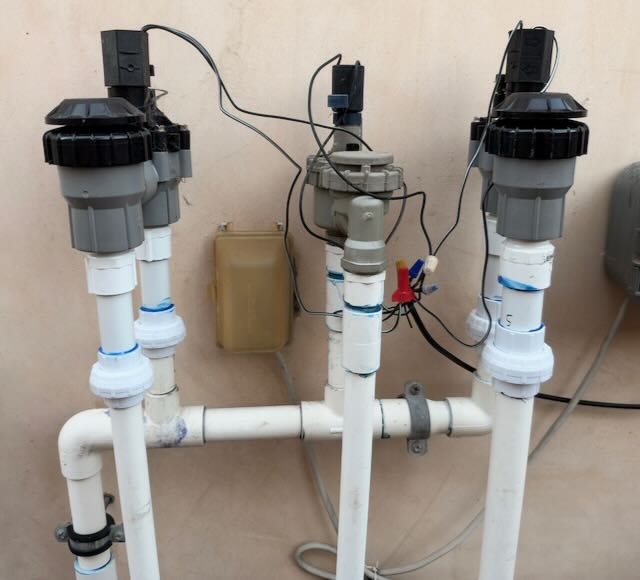
The most recent trouble spot was this valve manifold, where the incoming supply splits three ways for my three sprinkler zones, shown here after the project was finished.
A few years ago, the middle valve started leaking. I didn’t want to replace it because there wasn’t a shutoff valve, so I had a professional fix it and add a shutoff (not visible in the photo). Other than that change, he replaced it exactly as it had been, that is to say, a bunch of glued-together PVC.
One year ago, the left valve started leaking. There is no way to screw it off while it is attached, so I did the same thing the professional did, cutting and gluing new PVC, making use of the new shutoff valve.
As I mentioned, I’ve done this a lot at other places in the system, but one difference here is that one side of the valve is under constant pressure, unlike the sprinklers and underground connections, which are only under pressure when the sprinklers are running.
For my change a year ago, I didn’t quite screw the PVC connector hard enough into the valve. From the first day, it had a very slow drip. Barely enough to wet the ground, and not enough to convince me to recut and reglue, but enough to make me a little sad every time I walked past.
In the last month or so, the wet spot started to grow, both because the left connection was getting leakier, and the right valve was starting to fail as well.
I’m sure for a professional, it makes sense to just glue everything together, because they have figured out how to properly screw a connection in a way that doesn’t leak. But since I’m not a professional, I decided that this time I would give myself a way out.
Instead of gluing everything directly together, I installed two unions on each side. This way I can unscrew the entire unit and redo any connections if necessary. And the unions use an O-ring to keep the connection watertight, instead of my nemesis the NPT connection.
I didn’t replace the left valve since it was still good, but I did replace the connectors. And then of course I replaced the leaky right valve. I considered adding a union to the center valve, but decided to leave that for another day.
This time, I managed to get the left side tight enough (even though I wrapped the thread seal tape in the wrong direction), but I left the right side leaky. So my extra work paid off: I removed everything at the two unions, tightened up the leaky connection, and connected it together again. Voilà, for the first time in a year, the concrete is completely dry.
The lesson learned, I guess, is that as a newbie you sometimes have to over-engineer things to make up for your inevitable mistakes.